

Designing For Decision Clarity Under Operational Stress
Zero-waste grocery | Picker iOS app | Systems & operational UX
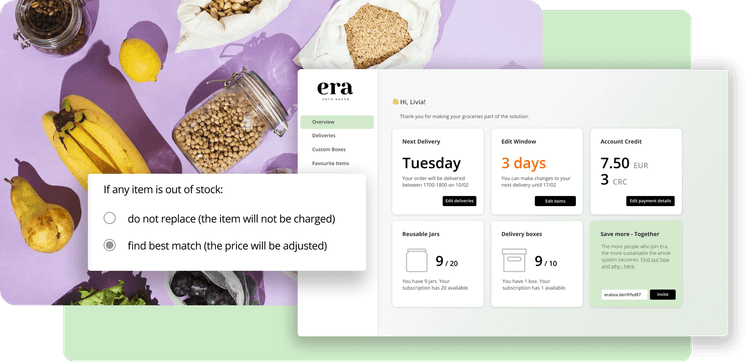
This project focused on improving operational clarity for warehouse pickers operating inside a fast-growing, zero-waste grocery platform with highly variable supply. The core challenge was not efficiency or speed, but decision responsibility: pickers were being asked to resolve ambiguity that properly belonged to the system.
My role was to redesign the picker experience so that humans report reality and the system resolves uncertainty, reducing cognitive load while increasing consistency, trust, and scalability.
Project Details
The Problem
The system promised customers flexibility ("accept substitutions"), but offloaded the interpretation of that promise onto pickers.
Pickers were repeatedly required to decide:
- what counted as "closest"
- whose preferences mattered
- how to balance value, freshness, and seasonality
- whether a substitution would be acceptable
These decisions occurred hundreds of times per shift, under time pressure, without feedback.
This was not a usability issue.
It was a misallocation of responsibility.
Existing Flow (Failure Mode)
Customer Order
↓
Resolution System (assumes stock)
↓
Picker discovers shortage
↓
Picker interprets intent
↓
Picker selects substitute
↓
No feedback / no learning
Observed outcomes:
- Decision fatigue
- Inconsistent substitutions
- Picker anxiety
- No system learning
- Poor scaling characteristics
Key Insight
"The issue was not substitution accuracy. It was substitution ownership. If the system promises ease to customers, it must absorb the ambiguity it creates. Pickers should not be the site where uncertainty is resolved.
Design Principle
Pickers confirm decisions.
Systems resolve uncertainty.
Humans act as sensors and executors - not interpreters of intent.
Design Response (System + Interface)
Responsibility Reallocation Model
[ Customer Intent ]
↓
[ Resolution System ]
(preferences + inventory belief)
↓
[ Picker Encounters Reality ]
↓
[ Picker Reports Facts ]
↓
[ System Recomputes Decision ]
↓
[ Picker Confirms Action ]
This creates:
- a real-time feedback loop
- explicit system accountability
- reduced cognitive burden at the point of work
Substitution Logic
Substitution was redesigned as a layered decision system:
1. Functional equivalence classes
Items grouped by role (e.g. "cooking greens", "breakfast dairy"), defining valid substitution boundaries.
2. User substitution intent
Customers express how substitutions should be handled, not item-by-item preferences.
3. Learned tolerance signals (ML-augmented)
The system learns acceptable variance across freshness, value, and seasonality.
4. Confidence-gated outcomes
Only high-confidence substitutions are surfaced.
Low-confidence cases auto-skip.
ML was used to increase confidence, not to replace judgment.
What This Demonstrates
How interaction design, system logic, and operational realities can align to protect human attention in complex, real-world environments.
This was operational systems design - relocating decision responsibility to where it belongs, enabling humans to work with clarity rather than constant interpretation.